
In Queensland, free hearing tests for newborns are offered to babies born in all public and private hospitals.
Hear and Say strongly advocated for the introduction of universal newborn hearing screening program which was implemented in Queensland in 2004.
Delivered by Queensland Health, the Healthy Hearing Program ensures that any hearing loss in newborns is detected early. Ensuring children have the best chance to reach their full speech and language potential.
If your newborn did not pass the newborn hearing test—also known as receiving a “refer” result—families can access free follow-up diagnostic services through the Healthy Hearing Program. This program is delivered through one of 13 paediatric audiology clinics across Queensland.
This includes Hear and Say’s centre in Ashgrove, Brisbane.
Referred to Hear and Say? Here’s What’s Next
One common cause for a “refer” result is fluid in the middle ear from the birthing process, which may take hours, days or even weeks to drain naturally. Because of this, a short wait is scheduled between the hospital screening and the follow-up diagnostic hearing test for your newborn, allowing time for this fluid to resolve.
- If your baby was referred for testing on both ears (a bilateral refer), Hear and Say will contact you as soon as the referral is received. A diagnostic appointment will be scheduled within two weeks of the initial screen to ensure any permanent hearing loss is identified quickly.
- If the referral is for one ear (a unilateral refer), an appointment will be made within six weeks.
Book your Newborn’s Hearing Assessment
How the Hearing Test for Newborns Works
At the diagnostic audiology appointment, parents/carers and their baby attend a series of comprehensive, painless tests to investigate any potential hearing loss. These tests help determine not only if there is hearing loss, but also where it is occurring—such as in the cochlea or along the auditory nerve.
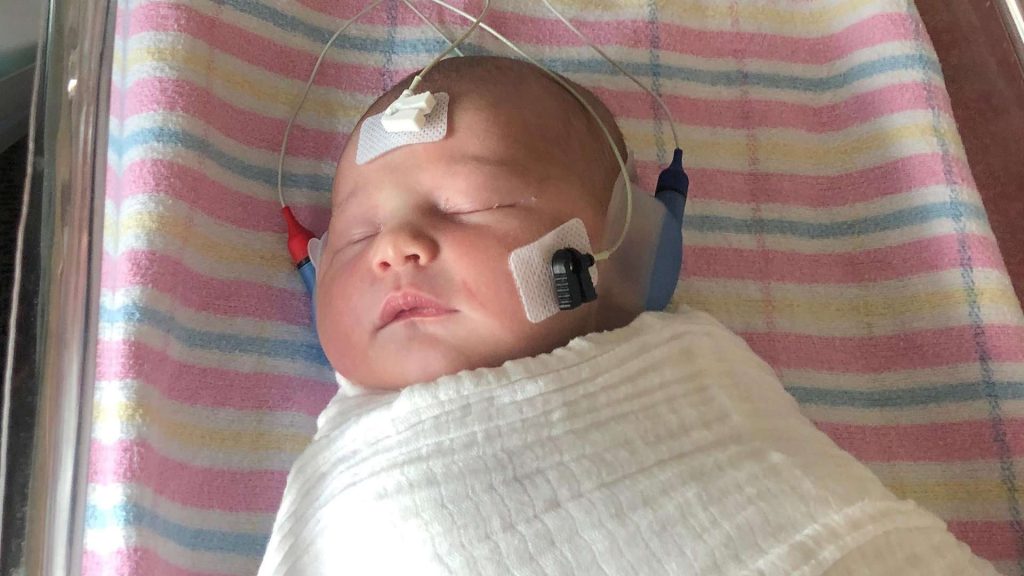
Babies need to be asleep during these assessments, known as Auditory Brainstem Response (ABR) testing to get accurate results.
“This can be no easy feat for families with a newborn, so we aim to create a calm, relaxed environment without time pressures,” said Hear and Say Audiologist, Annika Buntine.
“The most effective way to get a baby to sleep during the appointment is to feed them once they’re settled. We then place four small electrodes on the baby’s head, which are needed for the assessment.
“While the baby sleeps, a headphone is gently placed over the ear and sounds are played at different volumes. The electrodes pick up responses from the auditory nerve. The Healthy Hearing Program has strict criteria to ensure thorough testing at various intensity levels.”
The baby’s middle ear function is also evaluated using otoscopy (a visual check inside the ear and ear canal) and tympanometry (which assesses eardrum movement).
Another test checks the function of the cochlea, particularly the thousands of hair cells within it. Any movement or background noise can interfere with these tests, which is why the baby being asleep and calm—and the environment being quiet—is crucial.
“It’s common for babies not to sleep deeply or only take short naps during the appointment, but Hear and Say’s experienced audiology team is highly skilled in managing these situations,” said Annika.
If needed, the goal is to give babies early access to hearing technology—like hearing aids—by three months of age, and begin early intervention by six months.
Receiving the Results
If the initial diagnostic appointment suggests a hearing loss, the family will be invited to return one or two more times to confirm the results.
Once confirmed, referrals may be made to additional specialists, including:
- An Ear, Nose and Throat (ENT) specialist to investigate medical causes of hearing loss
- A hearing aid audiologist at Hearing Australia to assess whether amplification is suitable
- A paediatrician
- The Childhood Hearing Clinic at Queensland Children’s Hospital
Most families who attend Hear and Say for diagnostic testing enrol in our Early Intervention program, which supports children using hearing technology—such as hearing aids or cochlear implants. Healthy hearing is critical for children’s language development.
Book your newborn’s hearing assessment
Have any questions? We’re here to help.
Contact us