In 1978, Australian surgeon Professor Graeme Clark performed the world’s first successful cochlear implant surgery, marking the beginning of a new era for people with severe to profound hearing loss. Since then, cochlear implant technology has evolved rapidly. Early models featured bulky, body-worn processors, but today’s devices are sleek, compact, and worn behind or off the ear — many even offer Bluetooth streaming for seamless connectivity.
A cochlear implant is a surgically implanted device used to help people with severe or profound hearing loss. Unlike hearing aids, which simply make sounds louder, cochlear implants bypass damaged parts of the ear and deliver sound signals directly to the auditory nerve.
A cochlear implant has an external sound processor, worn behind the ear, which captures and codes sound, and an internal implant that sends electrical signals to electrodes in the cochlea. These signals stimulate the auditory nerve, allowing the brain to interpret them as sound.
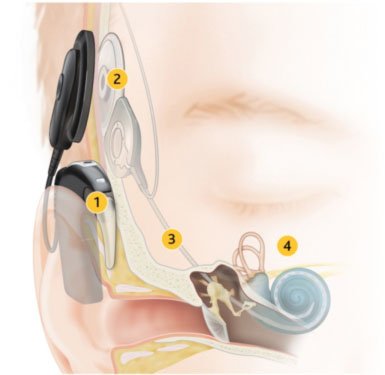
© Cochlear Limited 2025. This material is reproduced with the permission of Cochlear Limited.
The microphones, located on the external sound processor worn behind the ear or on the head, capture sounds from the environment. These sounds are then converted into digital signals by the processor.
The digital information is sent from the sound processor to the transmitter coil, which sits on the outside of the head. This coil wirelessly sends the signals through the skin to the internal implant.
The internal receiver, placed under the skin, receives the signals and converts them into electrical impulses. These impulses are then sent down to the electrode array inserted into the cochlea (inner ear).
The electrode array stimulates the hearing nerve fibres inside the cochlea. These nerve signals travel to the brain, where they are interpreted as sound.
Unlike hearing aids, which amplify sound to make it louder, cochlear implants bypass damaged parts of the inner ear and send sound directly to the hearing nerve.
The surgically implanted component of a cochlear implant includes:
Placed under the skin behind the ear, it receives signals from the external speech processor and converts them into electrical impulses.
A thin wire inserted into the cochlea that delivers these electrical impulses to specific regions of the auditory nerve.
Cochlear implants are suitable for individuals of all ages who have significant hearing loss in one or both ears and find that hearing aids do not provide adequate benefit.
Adapting to a cochlear implant takes time because the brain has to learn, or relearn, how to interpret sounds through this new device. Ongoing auditory training and support are essential for successful outcomes.
Cochlear implants can be life-changing for individuals with severe or profound hearing loss by providing access to sound when hearing aids are not effective.
Preparing for a cochlear implant involves several important steps that everyone typically follows:
The first step in the cochlear implant process is determining whether you are a suitable candidate. This involves a comprehensive evaluation conducted by a team of specialists to assess your medical, audiological, and communication needs.
The assessment typically includes:
These evaluations help ensure that a cochlear implant is the right option for you and allow the team to tailor the best possible care plan.
The cochlear implant surgery usually takes up to two hours and is performed by a specialised Ear, Nose, and Throat (ENT) surgeon with expertise in cochlear implants. During the procedure, the surgeon places the implant under the skin behind your ear, and the electrodes are carefully inserted into the inner ear. The implant is tested to ensure it is functioning properly before you leave theatre.
Cochlear implant surgery is generally safe and carries minimal risks. However, as with any surgical procedure, there are some potential risks to be aware of, including:
